Temperature enters Reynolds number through the fluid properties. Use a matching density/viscosity pair for the operating state.
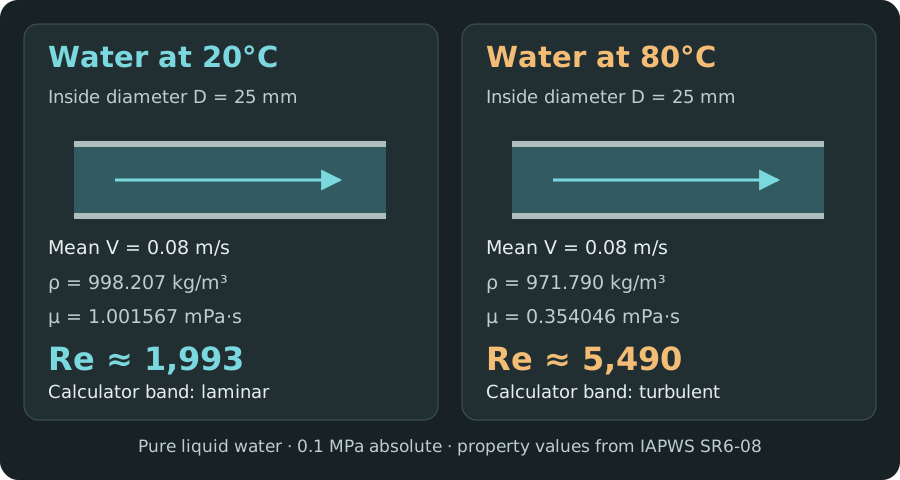
Temperature enters through density and viscosity
For a full circular pipe, Re = ρVD/μ = VD/ν. V is mean velocity, D is internal diameter, μ is dynamic viscosity, and ν = μ/ρ is kinematic viscosity. NASA's Reynolds-number explanation describes these equivalent forms.
Temperature does not appear as a separate term in the equation. It changes the properties that enter it. A density and viscosity pair should describe the same fluid, composition, temperature, and pressure. Mixing a cold density with a hot viscosity is not a complete operating-state calculation.
The calculator accepts properties you supply. It does not infer a fluid's operating temperature or look up viscosity automatically. Identify the actual condition before entering either form of viscosity.
One pipe and velocity, four water temperatures
Take pure liquid water at 0.1 MPa absolute, a 25 mm internal pipe diameter, and a mean velocity held at 0.08 m/s. The corresponding volumetric flow is about 0.039270 L/s, or 2.356 L/min. The following property values were calculated from IAPWS SR6-08(2011).
| Temperature (°C) | Density (kg/m³) | Dynamic viscosity (mPa·s) | Kinematic viscosity (cSt) | Re | Calculator band |
|---|---|---|---|---|---|
| 20 | 998.207 | 1.001567 | 1.003367 | 1,993.289 | Laminar |
| 40 | 992.216 | 0.652733 | 0.657854 | 3,040.187 | Transitional |
| 60 | 983.195 | 0.466039 | 0.474005 | 4,219.366 | Turbulent |
| 80 | 971.790 | 0.354046 | 0.364324 | 5,489.623 | Turbulent |
At 20°C, Re is about 1,993; at 80°C it is about 5,490. Density falls moderately, while dynamic viscosity falls much more. Their combined effect increases Re by about 2.754 times at the same velocity and diameter.
For a substitution you can check directly, the rounded 20°C properties give Re ≈ 998.207 × 0.08 × 0.025 / 0.001001567 ≈ 1,993.291. Notice the conversion from mPa·s to Pa·s. Using 1.001567 as though it were already in Pa·s would produce a result 1,000 times too small.
The calculator uses Re < 2,300 for laminar, 2,300 ≤ Re < 4,000 for transitional, and Re ≥ 4,000 for turbulent pipe flow. Inlet disturbances and geometry affect actual transition; see the Princeton discussion. A rounded result near a boundary needs particular care with the property and flow assumptions.
The printed digits help reproduce the arithmetic. They do not imply that real water properties, temperature measurements, or the resulting Re have that many significant figures. This table is for pure water at the stated pressure, not glycol mixtures, oils, gases, or arbitrary process fluids.
Match the viscosity type and units
Dynamic viscosity μ has units of Pa·s, mPa·s, or cP. Kinematic viscosity ν has units of m²/s, mm²/s, or cSt. They are related by density, but are not interchangeable numbers.
- 1 mPa·s = 1 cP = 0.001 Pa·s.
- 1 cSt = 1 mm²/s = 10⁻⁶ m²/s.
- When μ is in mPa·s and ρ in kg/m³, ν in cSt equals 1,000μ/ρ.
For the 20°C row, ν ≈ 1.003367 cSt. Entering the matching kinematic viscosity reproduces the dynamic-viscosity calculation, within input rounding. Density is not an additional input to Re = VD/ν because it is already included in ν.
Check what the system actually holds constant
The example holds mean velocity constant in the same circular pipe, so volumetric flow is also constant. A real pump and pipe system may change its flow as viscosity changes. Update V or Q if that happens; changing only the fluid properties could then miss part of the effect.
For constant mass flow ṁ in a circular pipe, Re = 4ṁ/(πDμ), because V = ṁ/(ρA). Density cancels under that particular constraint. This differs from assuming constant velocity. State which condition your comparison represents.
Use a fluid-property source that covers the fluid composition and operating pressure. Do not transfer the water table to an oil or a water/glycol blend. Do not assume every fluid responds to temperature in the same way. A strongly varying temperature along a pipe also calls for a stated representative condition or a calculation appropriate to the variation.
Inputs to use in the Reynolds Number Calculator
- Select Metric → Velocity → Dynamic viscosity.
- Enter internal diameter 25 mm and velocity 0.08 m/s.
- For 20°C, enter density 998.207 kg/m³ and dynamic viscosity 1.001567 mPa·s.
- For 80°C, change both properties to 971.790 kg/m³ and 0.354046 mPa·s.
The table uses full correlation values internally. Copying its rounded property values into the calculator gives approximately 1,993.291 and 5,489.626 respectively; the small differences are rounding effects.
Compare the operating conditionsSources and verification
- NASA Glenn — Reynolds Number
Re = ρVD/μ and ν = μ/ρ. - IAPWS SR6-08(2011) — Properties of Liquid Water at 0.1 MPa
Density from Equation 2/Table 1; viscosity from Equation 7/Table 5; implementation checked against Table 8. - Princeton University — Transition and Turbulence
Dependence of pipe-flow transition on disturbances and geometry.
The IAPWS density and viscosity implementation was checked against all three published sample points in Table 8. The four guide rows were then independently recomputed with the kinematic-viscosity form and compared with calculator outputs. Both full correlation values and the printed property inputs were checked.